The digital world thrives on the interplay between web development and software development, two distinct yet interconnected disciplines. While both involve creating solutions using code, their focus, methodologies, and end products differ significantly. Understanding these nuances is crucial for anyone navigating the tech landscape, whether as a developer, entrepreneur, or simply a curious individual.
This exploration delves into the core differences between web and software development, examining their respective skill sets, project scopes, career paths, and the unique challenges each presents. We’ll unravel the complexities of front-end, back-end, and full-stack web development, contrasting them with the broader world of software engineering encompassing desktop, mobile, and embedded systems.
Skill Sets and Technologies
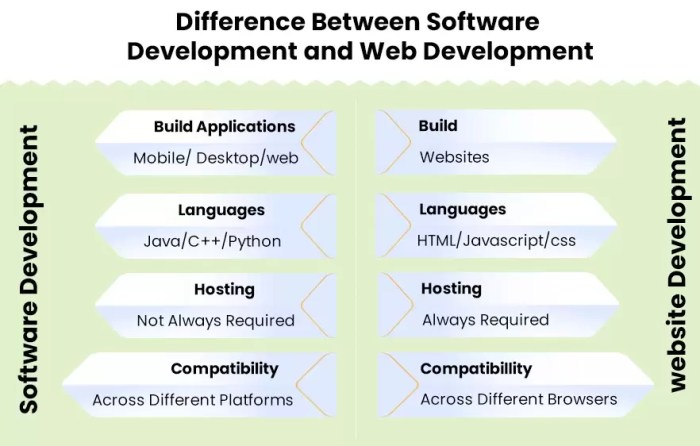
Web development and software development, while related, demand distinct skill sets and utilize different technologies. Understanding these differences is crucial for choosing the right career path and building a successful career in either field. This section will delve into the specific technical skills, programming languages, frameworks, and tools employed in each discipline.
Essential Technical Skills Comparison
The following table Artikels essential technical skills, comparing their proficiency levels in web and software development. Proficiency is represented qualitatively as High, Medium, or Low, reflecting the typical usage and importance within each field.
| Skill | Web Dev Proficiency | Software Dev Proficiency | Description |
|---|---|---|---|
| HTML, CSS, JavaScript | High | Low | Fundamental languages for building and styling websites; crucial for front-end web development. |
| Back-end Programming (e.g., Python, PHP, Node.js) | Medium | High | Languages and frameworks used to build server-side logic and databases; important for both, but more central to software development. |
| Database Management (SQL, NoSQL) | Medium | High | Skills in managing and interacting with databases, crucial for data persistence in both web and software applications. |
| API Integration | High | High | Ability to connect different software systems through APIs; essential for modern web and software applications. |
| Version Control (Git) | High | High | Using version control systems for collaborative development and tracking changes. |
| Software Design Principles (OOP, SOLID) | Medium | High | Understanding and applying design principles for building maintainable and scalable software. |
| Testing and Debugging | Medium | High | Identifying and resolving errors in code, crucial for both fields, but often more complex in software development. |
| UI/UX Design Principles | High | Low | Understanding user interface and user experience design for creating user-friendly applications, more critical in web development. |
Programming Languages and Frameworks
Web development frequently employs languages like HTML, CSS, JavaScript, along with back-end languages such as Python (with frameworks like Django or Flask), PHP (with frameworks like Laravel or Symfony), Ruby on Rails, or Node.js (with frameworks like Express.js). Popular front-end frameworks include React, Angular, and Vue.js.Software development utilizes a broader range of languages depending on the application’s purpose. Common choices include Java, C++, C#, Python, Go, and Swift.
Frameworks vary significantly based on the language and application type, ranging from .NET for Windows applications to Spring Boot for Java applications or various machine learning frameworks like TensorFlow or PyTorch.
Specialized Tools and Technologies
Both fields leverage specialized tools. Web development often uses tools like browser developer tools for debugging, content management systems (CMS) like WordPress or Drupal, and various testing frameworks (e.g., Selenium, Jest). Software development commonly utilizes integrated development environments (IDEs) like Eclipse or Visual Studio, debugging tools specific to the programming language, and various testing and deployment tools. Containerization technologies like Docker are also becoming increasingly important in both fields.
Typical Project Workflows
The following descriptions illustrate the typical workflows. Note that these are simplified representations and actual workflows can be significantly more complex. A typical web development project workflow might involve: 1. Gathering requirements and planning; 2. Designing the UI/UX; 3. Developing the front-end; 4. Developing the back-end; 5. Integrating the front-end and back-end; 6. Testing; 7. Deployment; 8. Maintenance and updates.A typical software development project workflow often follows a more structured approach, potentially utilizing methodologies like Agile or Waterfall. This usually includes: 1. Requirements gathering and analysis; 2. Design (including database design); 3. Implementation (coding); 4. Testing (unit, integration, system); 5. Deployment; 6. Maintenance and support. The software development lifecycle may involve more rigorous planning and documentation compared to web development projects.
Project Scope and Complexity
Web development and software development projects vary significantly in scope and complexity, influenced by factors such as the project’s goals, the technology used, and the client’s requirements. While both fields encompass a wide range of project sizes, there are noticeable differences in typical project scales and the associated challenges.Web development projects often focus on creating user interfaces and functionalities accessible through web browsers.
Software development, conversely, encompasses a broader spectrum, including the creation of desktop applications, mobile apps, embedded systems, and complex backend systems that may or may not have a web interface.
Project Scale Examples
The scale of projects in both fields can be categorized into small, medium, and large, based on factors like the number of developers involved, the development time, and the overall budget.Small-scale web development projects might involve creating a simple static website with a few pages, perhaps using a website builder or a basic content management system (CMS) like WordPress. A small-scale software project could be a simple utility application, such as a basic calculator or a to-do list manager.Medium-scale web development projects might include building an e-commerce website with user accounts, a shopping cart, and payment integration.
A medium-scale software project could be a moderately complex application, such as a project management tool or a simple inventory management system.Large-scale web development projects often involve complex web applications with many features, extensive user interaction, and high traffic volume. Examples include large-scale e-commerce platforms like Amazon or social media networks like Facebook. Large-scale software projects could be enterprise resource planning (ERP) systems, complex financial modeling applications, or large-scale gaming applications.
These often involve hundreds of developers and significant budgets.
Project Lifecycle Stages
While the specific stages may vary depending on the methodology employed (Agile, Waterfall, etc.), both web and software development projects generally follow similar lifecycle phases. These include: planning and requirements gathering, design, development, testing, deployment, and maintenance. However, the emphasis and duration of each stage can differ considerably. Web development projects often prioritize faster iterations and quicker deployments, sometimes employing Agile methodologies heavily.
Software development projects, particularly large-scale ones, might follow a more structured Waterfall approach, with a greater emphasis on upfront planning and detailed documentation.
Factors Influencing Project Duration and Resource Allocation
Several factors influence the duration and resource allocation for both web and software development projects.
- Project Complexity: More complex projects, with intricate features and integrations, naturally require more time and resources.
- Team Size and Expertise: A larger, more experienced team can generally complete a project faster, although this also increases costs.
- Technology Stack: The chosen technologies (programming languages, frameworks, databases) can significantly impact development time and resource needs. Some technologies are more efficient or have better tooling than others.
- Client Involvement and Feedback: Frequent client feedback and changes can extend the project timeline.
- Testing and Quality Assurance: Thorough testing is crucial, but it adds to the project’s duration and resource requirements.
- Unexpected Issues and Bugs: Unforeseen technical challenges and bug fixes can cause delays and increase costs.
Career Paths and Opportunities
Choosing a career in either web development or software development opens doors to a wide range of opportunities, each with its own unique trajectory and potential for growth. Both fields offer diverse career paths, varying levels of responsibility, and substantial earning potential, although the specifics differ based on specialization and experience.
Web Development Career Paths
Web development encompasses various specializations, each leading to distinct career paths. A junior web developer might focus on front-end development, mastering HTML, CSS, and JavaScript to create user interfaces. With experience, they could progress to senior roles, taking on more complex projects and mentoring junior team members. Alternatively, a specialization in back-end development might lead to roles like API developer or database administrator, focusing on server-side logic and data management.
Full-stack developers possess expertise in both front-end and back-end development, often leading project teams and managing entire web applications. Other specialized roles include UX/UI designers, focusing on user experience and interface design, and DevOps engineers, managing the deployment and maintenance of web applications.
Web Development Career Progression and Salary Expectations
Career progression in web development typically follows a clear path. Starting as a junior developer, individuals gain experience and skills, leading to senior developer roles, then potentially team lead or technical architect positions. Salaries vary widely based on location, experience, and specialization. Entry-level web developers might earn between $50,000 and $70,000 annually in many regions, while senior developers can command salaries exceeding $100,000 or more.
Highly specialized roles, such as those in emerging technologies like AI or blockchain, often attract even higher compensation. For example, a senior full-stack developer with expertise in React and Node.js might earn a significantly higher salary than a junior front-end developer with limited experience.
Software Development Career Paths
Software development offers a broader range of specializations than web development. This includes areas like game development, mobile app development, embedded systems programming, and data science. Career paths often involve progressing from junior software engineer to senior software engineer, then to architect, team lead, or technical manager. Specialized roles might include database engineers, security engineers, or DevOps engineers, depending on the specific area of expertise.
Comparison of Career Paths and Opportunities
While both fields offer diverse career paths, software development generally provides a wider range of specializations and potentially higher earning potential in some areas, such as AI or machine learning. Web development, however, is currently experiencing rapid growth, creating a high demand for skilled professionals. The choice often depends on individual interests and aptitudes. For instance, a person interested in creating interactive user interfaces might find web development more appealing, while someone passionate about developing complex algorithms might prefer software development.
Freelance Work and Entrepreneurship
Both web and software development lend themselves well to freelance work and entrepreneurship. Freelancers can offer their services on platforms like Upwork or Fiverr, building websites, developing applications, or providing consulting services. Entrepreneurs can create their own software companies, developing and selling their own products or offering custom software solutions to clients. The flexibility and potential for high earnings make both freelance and entrepreneurial paths attractive options for skilled professionals in both fields.
For example, a successful freelance web developer might earn a higher hourly rate than a similarly skilled employee at a company, while a software entrepreneur could potentially build a highly valuable business around a successful software product.
Ultimately, the choice between web and software development hinges on individual interests and aptitudes. Web development offers a dynamic environment with immediate visual results and a focus on user experience. Software development, on the other hand, provides the opportunity to build complex, robust systems that underpin many aspects of modern life. Both fields are constantly evolving, demanding continuous learning and adaptation, ensuring a rewarding and intellectually stimulating career for those who embrace the challenge.
Helpful Answers
What are the salary expectations for each field?
Salaries vary greatly based on experience, location, and specific skills. Generally, experienced software developers tend to earn higher salaries than web developers, but both fields offer competitive compensation.
Which field is more in-demand?
Both fields are consistently in high demand, but the specific needs fluctuate based on market trends. Currently, there’s a significant demand for both web developers skilled in front-end frameworks and software engineers specializing in areas like AI and machine learning.
Is it possible to transition from one field to the other?
Yes, many developers successfully transition between web and software development. A strong foundation in programming principles and a willingness to learn new technologies are key to a smooth transition.


