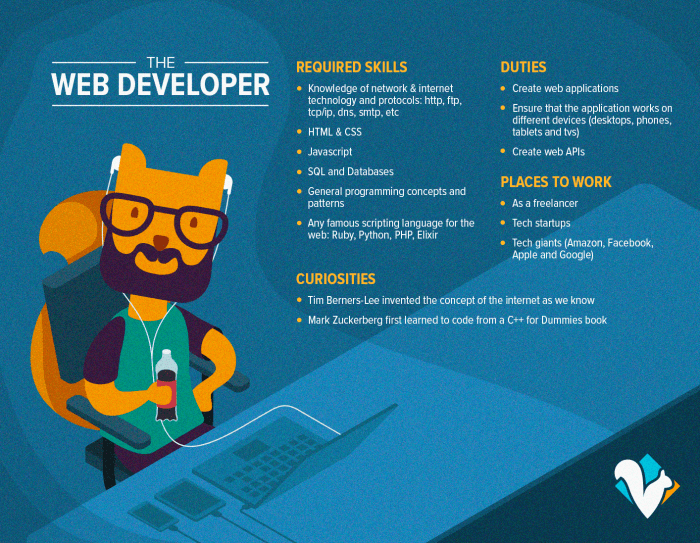
Embark on a journey into the dynamic world of web development. This guide unveils the multifaceted paths to becoming a successful web developer, exploring front-end, back-end, and full-stack specializations. We’ll delve into essential skills, learning resources, portfolio building, and job search strategies, equipping you with the knowledge to navigate this exciting field.
From understanding fundamental concepts like HTTP requests to mastering popular frameworks like React and Node.js, we’ll provide a comprehensive overview of the tools and technologies that power the modern web. This guide is designed for aspiring developers of all levels, whether you’re a complete beginner or looking to enhance your existing skills.
Understanding Web Development
Web development encompasses the creation and maintenance of websites and web applications. It’s a broad field, often categorized into three main areas: front-end, back-end, and full-stack development. Each area requires a unique skillset and focuses on different aspects of the website’s functionality and user experience. Understanding these distinctions is crucial for anyone aspiring to become a web developer.
Front-End Web Development
Front-end development focuses on the user interface (UI) and user experience (UX) of a website. This is what the user directly interacts with – the visual elements, layout, and responsiveness. Front-end developers are responsible for ensuring the website looks good and functions smoothly across different devices and browsers.Skills required for front-end development include HTML (for structuring content), CSS (for styling and layout), and JavaScript (for adding interactivity and dynamic behavior).
Proficiency in responsive design principles and frameworks like React, Angular, or Vue.js is also highly valuable. Understanding user interface design principles and best practices is essential.Examples of popular programming languages used in front-end development include JavaScript, TypeScript (a superset of JavaScript), and HTML (although technically a markup language, not a programming language, it’s fundamental to front-end development).
Back-End Web Development
Back-end development handles the server-side logic and database interactions of a website. This includes processing user requests, managing data, and ensuring the website’s security. The back-end is the engine that powers the front-end, making it function as intended. Back-end developers rarely see the visual aspects of the website; their work happens behind the scenes.Essential skills for back-end development include proficiency in server-side programming languages, database management systems (DBMS), and API design.
Understanding security best practices is paramount to prevent vulnerabilities. Familiarity with cloud platforms like AWS, Google Cloud, or Azure is also beneficial.Popular programming languages used in back-end development include Python, Java, Node.js (JavaScript runtime environment), PHP, Ruby, and Go. Database systems frequently used include MySQL, PostgreSQL, MongoDB, and others.
Full-Stack Web Development
Full-stack developers possess skills in both front-end and back-end development. They have a comprehensive understanding of the entire web development process, from the user interface to the server-side logic and database management. This allows them to work on all aspects of a website or web application, making them highly versatile and valuable members of a development team.Full-stack developers need a broad range of skills, encompassing those listed for both front-end and back-end development.
They also need a strong understanding of how different parts of a web application interact and work together. The ability to work efficiently and effectively across different layers of the application is crucial. Experience with various frameworks and technologies is highly beneficial.
Comparison of Front-End and Back-End Development Roles
| Feature | Front-End Development | Back-End Development |
|---|---|---|
| Primary Focus | User Interface and User Experience | Server-side Logic and Database Management |
| Key Technologies | HTML, CSS, JavaScript, React, Angular, Vue.js | Python, Java, Node.js, PHP, SQL, NoSQL databases |
| User Interaction | Directly interacts with the user | Works behind the scenes |
Choosing a Specialization

Choosing your specialization in web development is a crucial step, significantly impacting your career trajectory and the types of projects you’ll work on. Understanding the differences between front-end, back-end, and full-stack development is essential for making an informed decision. Each path offers unique challenges, rewards, and job market demands.
Front-End Development
Front-end developers focus on the user interface (UI) and user experience (UX) of a website or application. They are responsible for the visual aspects, ensuring the site is visually appealing, user-friendly, and responsive across different devices. The job market for front-end developers remains consistently strong, driven by the ever-growing demand for engaging and accessible online experiences.Specific technologies associated with front-end development include HTML, CSS, JavaScript, and various JavaScript frameworks like React, Angular, and Vue.js.
Proficiency in these technologies is essential for creating dynamic and interactive user interfaces.The career paths available within front-end development are diverse. A front-end developer can progress to senior front-end developer, lead front-end developer, or even specialize in areas like UX design or accessibility.
- Front-End Developer
- Senior Front-End Developer
- Lead Front-End Developer
- UX/UI Specialist
- Accessibility Specialist
Back-End Development
Back-end developers work behind the scenes, handling the server-side logic and database interactions of a website or application. They ensure the application functions correctly, processes data efficiently, and remains secure. The demand for back-end developers is also high, with companies constantly seeking individuals to build robust and scalable systems.Popular back-end technologies include various programming languages like Python, Java, PHP, Node.js, and frameworks such as Django, Spring, Laravel, and Express.js.
Database technologies like SQL and NoSQL are also crucial skills.Career progression for back-end developers often leads to roles with increased responsibility and technical expertise.
- Back-End Developer
- Senior Back-End Developer
- Database Administrator
- DevOps Engineer
- Cloud Architect
Full-Stack Development
Full-stack developers possess skills in both front-end and back-end development, allowing them to work on all aspects of a web application. This versatility is highly valued, making full-stack developers highly sought after. However, the breadth of knowledge required can be challenging, demanding a broad and deep understanding of various technologies. The job market for full-stack developers reflects this high demand, though competition can be fierce due to the wide range of skills needed.A full-stack developer needs expertise in both front-end and back-end technologies mentioned above.
Additionally, a strong understanding of DevOps principles and cloud platforms is becoming increasingly important.Career paths for full-stack developers are similarly diverse, often involving leadership roles or specialization in specific areas.
- Full-Stack Developer
- Senior Full-Stack Developer
- Team Lead
- Technical Architect
- Software Engineer
Learning Resources and Paths
Embarking on a web development journey requires careful consideration of learning resources and pathways. The right approach significantly impacts your learning speed, effectiveness, and overall cost. Several avenues exist, each with its strengths and weaknesses. Choosing wisely is crucial for a successful outcome.
The most common learning paths involve online courses, bootcamps, and self-directed learning. Each method offers a unique learning experience and requires a different level of commitment and financial investment. Understanding the pros and cons of each will help you choose the best fit for your learning style, budget, and timeline.
Online Courses
Online courses offer a flexible and often affordable way to learn web development. Platforms like Coursera, edX, Udemy, and Codecademy provide a vast library of courses catering to different skill levels and specializations. These courses often include video lectures, interactive exercises, and quizzes, offering a structured learning experience. The cost varies widely, with some free courses available and others costing hundreds of dollars.
The effectiveness depends heavily on self-discipline and time management, as the learning environment is less structured than a bootcamp.
Bootcamps
Web development bootcamps are intensive, short-term programs that provide a fast-paced, immersive learning experience. They typically last for several weeks or months and involve full-time commitment. Bootcamps offer structured curriculum, hands-on projects, and often include career services to help graduates find jobs. However, bootcamps can be significantly more expensive than online courses, and the fast-paced nature may not suit all learning styles.
The effectiveness of a bootcamp depends heavily on the quality of the program and the instructor’s expertise. Successful completion often leads to a portfolio of projects and increased job prospects.
Self-Learning
Self-learning involves independently acquiring web development skills through various resources like online documentation, tutorials, and books. This approach offers maximum flexibility and control over the learning pace and content. However, it requires significant self-discipline, motivation, and the ability to troubleshoot problems independently. The cost can be relatively low, primarily involving the cost of books or online subscriptions. The effectiveness relies heavily on the learner’s ability to stay focused and motivated, and finding reliable and up-to-date resources is crucial.
Successful self-learners often demonstrate exceptional problem-solving skills and resourcefulness.
Reputable Online Resources for Learning Web Development
Choosing quality resources is vital for effective learning. The following list categorizes reputable online resources based on skill level:
This list is not exhaustive but represents a good starting point for your web development journey. Remember that consistent practice and building projects are crucial regardless of the learning path chosen.
| Skill Level | Resource | Description |
|---|---|---|
| Beginner | freeCodeCamp | Offers interactive coding challenges and certifications. |
| Beginner | Codecademy | Provides interactive courses on various programming languages and web development concepts. |
| Intermediate | MDN Web Docs | Comprehensive documentation for web technologies. |
| Intermediate | Udemy (Specific Courses) | Offers a wide range of courses, many focusing on specific frameworks and libraries. Carefully review course ratings and reviews. |
| Advanced | YouTube Channels (e.g., Traversy Media, The Net Ninja) | Provides in-depth tutorials and explanations of advanced concepts. |
| Advanced | Official Documentation of Frameworks/Libraries (React, Angular, Node.js, etc.) | The most authoritative source for understanding the nuances of specific technologies. |
Building a Portfolio
A strong portfolio is your most effective tool for showcasing your web development skills and securing your dream job. It’s a dynamic representation of your abilities, allowing potential employers to assess your technical proficiency, creativity, and problem-solving skills firsthand. Without a compelling portfolio, even a strong resume may fall short in demonstrating your practical capabilities.Your portfolio serves as a tangible demonstration of your skills, far surpassing the claims made in a resume or cover letter.
It allows you to present your best work, highlighting your unique approach to web development and demonstrating your mastery of various technologies and design principles. A well-curated portfolio will significantly improve your chances of landing interviews and ultimately securing a desirable position.
Impressive Portfolio Project Examples
Examples of impressive portfolio projects showcase a range of skills and project complexities. A simple, well-executed personal website demonstrates fundamental HTML, CSS, and JavaScript skills, while a more advanced project, such as an e-commerce platform or a complex web application, highlights expertise in backend development, database management, and potentially frameworks like React, Angular, or Vue.js. A portfolio that includes projects demonstrating responsiveness across different devices (desktops, tablets, and mobile phones) is particularly valuable.Consider projects that involve interactive elements, animations, and user-friendly interfaces.
A portfolio showcasing a project with a clean and intuitive design will stand out. Furthermore, projects that tackle real-world problems or address specific user needs often leave a lasting impression. For example, a portfolio showcasing a website built for a non-profit organization demonstrates both technical skill and social responsibility.
Creating a Compelling Portfolio Website: A Step-by-Step Guide
Building your portfolio website requires a structured approach. First, select your best projects – those that best represent your abilities and showcase your preferred technologies. Next, choose a suitable platform; popular options include platforms like Squarespace or Wix for ease of use, or more advanced options like using a static site generator (like Jekyll or Hugo) or building a custom site using frameworks like React.Once you have chosen your platform, meticulously design the layout of your website.
Ensure that it is clean, easy to navigate, and visually appealing. Use high-quality images and concise descriptions to showcase your projects. For each project, provide a brief overview, highlighting the technologies used and the challenges overcome. Include links to live demos (if available) and the project’s source code on platforms like GitHub.Finally, optimize your portfolio for search engines () to increase its visibility.
Use relevant s in your descriptions and meta tags. Regularly update your portfolio with new projects to demonstrate continuous learning and skill development. This consistent effort will demonstrate your dedication and passion to potential employers.
Portfolio Projects Demonstrating Specific Skills
A well-rounded portfolio should demonstrate a variety of skills. For example, a project featuring a responsive website demonstrates adaptability across various screen sizes. The project could showcase a blog or a portfolio site itself, adapting its layout seamlessly to desktops, tablets, and mobile phones. This illustrates proficiency in responsive design principles and the use of CSS frameworks like Bootstrap or Tailwind CSS.Another project could highlight database interaction.
This might involve building a simple to-do list application or a more complex project such as a social media platform. This project will showcase your understanding of database management systems (like MySQL, PostgreSQL, or MongoDB) and your ability to interact with them using appropriate programming languages and frameworks. Finally, a project demonstrating API integration (e.g., connecting to a weather API or a social media API) will showcase your ability to work with external services, demonstrating your understanding of RESTful APIs and JSON.
Job Search Strategies
Securing your first web development role requires a strategic and proactive approach. This section Artikels effective strategies to maximize your chances of landing your dream job, encompassing job searching techniques, networking, and leveraging various job platforms.
The job search for a web developer is competitive, but with the right strategies, you can significantly increase your chances of success. A well-crafted resume and cover letter, combined with a targeted approach to job applications and networking, are key components of a successful job hunt.
Effective Job Search Methods
A multi-pronged approach to job searching is recommended. Relying solely on one method limits your exposure to potential opportunities. A combination of online platforms, networking, and direct applications yields the best results.
- Online Job Boards: Utilize popular platforms like LinkedIn, Indeed, Glassdoor, and specialized tech job boards such as Stack Overflow Jobs. Regularly search for relevant s and tailor your application materials to each specific job description.
- Company Websites: Many companies post open positions directly on their career pages. Checking the “Careers” or “Jobs” sections of websites for companies you admire can uncover hidden opportunities not listed on general job boards.
- Networking Events: Attend industry meetups, conferences, and workshops to connect with professionals in the field. These events provide invaluable networking opportunities and can lead to unadvertised job openings.
- Direct Applications: Even if a company isn’t actively advertising a role, sending a speculative application demonstrating your skills and interest can sometimes lead to unexpected opportunities. Research companies you are interested in and tailor your application to their specific needs.
The Importance of Networking and Building Professional Connections
Networking is crucial for web developers. Building strong professional relationships can significantly increase your chances of finding a job. It’s not just about collecting contacts; it’s about cultivating genuine connections and establishing yourself as a valuable member of the community.
- LinkedIn: Actively engage on LinkedIn. Optimize your profile, connect with recruiters and other professionals, and participate in relevant groups and discussions.
- Industry Events: Attend conferences, workshops, and meetups to network with other developers and potential employers. Prepare a concise elevator pitch to introduce yourself and your skills.
- Online Communities: Participate in online forums, such as Stack Overflow, GitHub, and other relevant communities. Contributing to discussions and helping others showcases your expertise and builds your reputation.
- Informational Interviews: Reach out to professionals in your desired field for informational interviews. These conversations can provide valuable insights into the industry, potential job opportunities, and help you build relationships.
Job Platforms and Resources
Several platforms and resources specialize in connecting web developers with job opportunities. Choosing the right platforms depends on your experience level, specialization, and location.
- LinkedIn: A leading professional networking site with a robust job board.
- Indeed: A comprehensive job board with a wide range of web development roles.
- Glassdoor: Provides insights into company culture, salaries, and interview experiences.
- Stack Overflow Jobs: A specialized job board for developers, focusing on technical roles.
- AngelList: Focuses on startup and tech company jobs.
Sample Cover Letter and Resume
A well-crafted cover letter and resume are essential for making a strong first impression. Tailor these documents to each specific job application, highlighting the skills and experience most relevant to the position.
Sample Resume (Extract):
Jane Doe
[email protected] | (123) 456-7890 | linkedin.com/in/janedoe
Summary
Highly motivated and experienced Web Developer with 3+ years of experience in designing, developing, and maintaining responsive websites using HTML, CSS, JavaScript, and various frameworks. Proven ability to collaborate effectively within agile development teams to deliver high-quality projects on time and within budget.
Skills
HTML5, CSS3, JavaScript, React, Node.js, Git, Agile methodologies, Responsive design, RESTful APIs, SQL, Testing frameworks (Jest, Mocha).
Experience
Web Developer, Acme Corporation (2020-Present)
Developed and maintained several company websites, resulting in a 20% increase in user engagement. Implemented a new CMS, improving content management efficiency by 15%.
Sample Cover Letter (Extract):
Dear [Hiring Manager Name],
I am writing to express my keen interest in the Web Developer position advertised on [Platform]. With my 3+ years of experience in developing and maintaining responsive websites using technologies such as React, Node.js, and SQL, I am confident I possess the skills and experience to excel in this role and significantly contribute to [Company Name]. My experience at Acme Corporation demonstrates my ability to collaborate effectively within agile teams and deliver high-quality projects on time and within budget.
I am particularly excited about [mention specific project or aspect of the job description that interests you]. Thank you for your time and consideration. I have attached my resume for your review and welcome the opportunity to discuss my qualifications further.
Sincerely,
Jane Doe
The path to becoming a proficient web developer is a rewarding but demanding journey. By mastering the skills Artikeld in this guide, including choosing a specialization, building a compelling portfolio, and continuously learning, you can significantly increase your chances of success. Remember, the web development landscape is constantly evolving, so embrace continuous learning to remain at the forefront of this dynamic field.
Your dedication and persistence will pave the way to a fulfilling career in this exciting industry.
Q&A
What is the average salary for a web developer?
Salaries vary widely based on experience, location, and specialization. Entry-level positions may offer lower salaries, while senior developers can earn significantly more.
How long does it take to become a web developer?
The time commitment depends on your learning style, prior experience, and chosen learning path. Bootcamps offer intensive, shorter programs, while self-learning may take longer.
Do I need a college degree to become a web developer?
While a college degree isn’t strictly required, it can be beneficial. Many successful web developers learn through bootcamps, online courses, or self-study.
Which programming language should I learn first?
There’s no single “best” language. For front-end, consider HTML, CSS, and JavaScript. For back-end, options include Python, Java, PHP, or Node.js. The choice often depends on your specialization.


