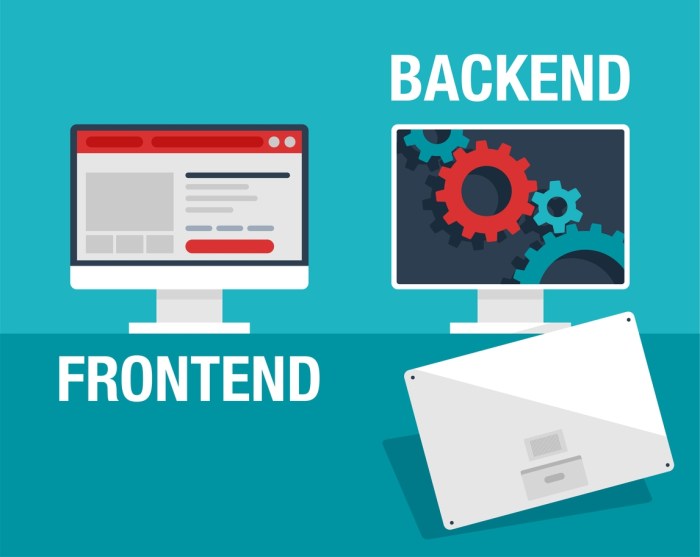
The digital world thrives on the seamless interaction between front-end and back-end development. While both are crucial for a functional website or application, they represent distinct disciplines with unique skill sets and responsibilities. Understanding their differences is key to appreciating the complexity and artistry involved in creating engaging online experiences.
This exploration delves into the core functions of each, highlighting the technologies involved, the collaborative nature of their relationship, and the crucial role they play in delivering a positive user experience. We’ll examine common frameworks, security considerations, and the overall web development lifecycle, offering a clear picture of how these two sides work together to build the internet as we know it.
Defining Front-End and Back-End Development
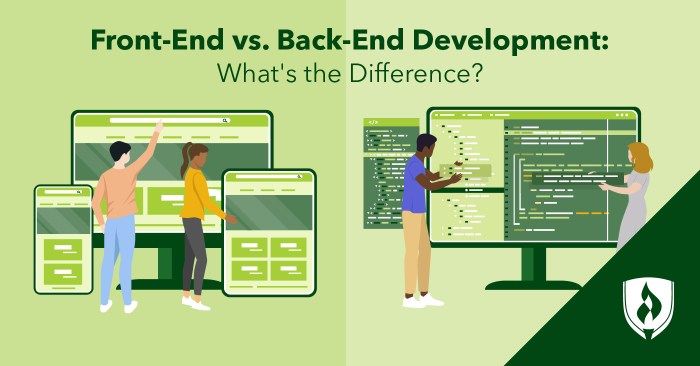
Front-end and back-end development are two distinct but interconnected aspects of web development. Understanding their differences is crucial for anyone aiming to navigate the world of software engineering or web design. While both are essential for a fully functional website or application, they address different aspects of the user experience and the underlying functionality.
Front-End Developer Responsibilities
Front-end developers are responsible for everything the user sees and interacts with directly. This includes the visual layout, the user interface (UI), and the user experience (UX). They translate designs and wireframes into functional and aesthetically pleasing websites and applications. Their work directly impacts the user’s perception and engagement with the product.
Front-End Technologies
The core technologies used in front-end development are HTML, CSS, and JavaScript. HTML (HyperText Markup Language) provides the structure and content of a webpage. CSS (Cascading Style Sheets) controls the visual presentation, including layout, colors, and fonts. JavaScript adds interactivity and dynamic behavior, allowing for features like animations, form validation, and real-time updates. Beyond these fundamentals, front-end developers often utilize frameworks and libraries like React, Angular, or Vue.js to streamline development and improve code organization.
These frameworks provide pre-built components and structures, accelerating the development process and ensuring consistency across projects.
Back-End Developer Responsibilities
Back-end developers focus on the server-side logic and database interactions that power a website or application. They build the infrastructure that supports the front-end, handling data storage, processing, and security. They ensure the smooth and efficient functioning of the application behind the scenes, often working with APIs (Application Programming Interfaces) to connect the front-end and back-end. Their primary concern is the functionality and scalability of the application, rather than the visual presentation.
Back-End Technologies
Back-end development utilizes a wide range of technologies. Popular choices include programming languages like Python, Node.js (JavaScript), Java, PHP, Ruby, and frameworks such as Django (Python), Express.js (Node.js), Spring (Java), and Ruby on Rails. Databases, such as MySQL, PostgreSQL, MongoDB, and others, are integral to storing and managing application data. These databases provide structured or unstructured ways to organize and retrieve information efficiently.
The choice of technology often depends on the project’s specific requirements and the developer’s expertise.
Front-End and Back-End Skill Set Comparison
While both roles require strong problem-solving and logical thinking skills, the specific skill sets differ significantly. Front-end developers need a deep understanding of HTML, CSS, and JavaScript, along with a strong grasp of user interface design principles and user experience best practices. They often collaborate closely with designers and UX specialists. Back-end developers require expertise in server-side programming languages, database management, and API design.
They typically possess strong knowledge of data structures, algorithms, and security best practices. While some overlap exists, particularly in areas like JavaScript (used in both front-end and back-end development with Node.js), the core competencies and daily tasks are quite distinct.
The User Interface (UI) and User Experience (UX)
The user interface (UI) and user experience (UX) are crucial aspects of web development, directly impacting a website’s success. A well-designed UI and UX ensure users can easily navigate and interact with the website, achieving their goals efficiently and enjoyably. Poor UI/UX design, conversely, can lead to frustration, abandonment, and ultimately, failure.
UI and UX are closely related but distinct concepts. UI refers to the visual elements – the layout, typography, imagery, and interactive components – that users see and interact with. UX encompasses the overall experience a user has when interacting with a website, including ease of use, efficiency, and overall satisfaction.
Designing a Simple and Intuitive User Interface
Designing a user interface that prioritizes simplicity and intuitive navigation is paramount. This involves careful consideration of information architecture, visual hierarchy, and interaction design. A well-structured UI guides users seamlessly through the website, allowing them to find the information or complete the tasks they need efficiently. The following HTML table illustrates a basic structure emphasizing simplicity:
| Section | Description |
|---|---|
| Navigation Bar | Clear, concise links to main sections of the website. |
| Hero Section | Prominent display of key information or call to action. |
| Content Area | Well-organized content with clear headings and subheadings. |
| Footer | Copyright information, contact details, and links to relevant pages. |
The Importance of User Experience in Web Development
User experience is paramount to the success of any website. A positive UX fosters user engagement, loyalty, and ultimately, conversions. A website with poor UX will likely lead to high bounce rates, negative reviews, and lost business. Investing in UX design is an investment in the long-term success of the website. For example, a poorly designed e-commerce website with a complicated checkout process might cause users to abandon their purchases, leading to significant revenue loss.
Conversely, a well-designed website with a seamless checkout process increases conversion rates and boosts sales.
Front-End Development’s Impact on User Experience
Front-end development directly shapes the user experience. Front-end developers are responsible for translating UI designs into functional, interactive web pages. The choices they make regarding code structure, responsiveness, and accessibility directly impact how users perceive and interact with the website. For example, slow loading times, unresponsive layouts, or inaccessible content all negatively affect user experience and can lead to frustration and abandonment.
Efficient, well-structured code ensures a smooth and enjoyable user experience.
Common UX Design Principles
Effective UX design relies on several core principles. These principles guide the design process and ensure a positive user experience. These include:
These principles work together to create a cohesive and user-friendly experience. For instance, consider an online banking application. Applying the principle of consistency ensures that the user interface remains familiar and predictable throughout the application. Meanwhile, usability focuses on making it easy for users to perform essential tasks like transferring funds or checking balances. Finally, accessibility ensures users with disabilities can also easily access and use the application.
Database Interactions and Server-Side Logic
Back-end development forms the unseen engine driving the functionality of web applications. It’s responsible for managing data, executing business logic, and ensuring seamless communication between the user interface and the underlying data storage. This crucial layer dictates how efficiently and reliably an application functions.Back-end development handles data storage and retrieval through the use of databases. These databases are essentially organized collections of information, structured to allow for efficient storage, retrieval, modification, and deletion of data.
The back-end uses server-side code (written in languages like Python, Java, Node.js, etc.) to interact with these databases, translating user requests into database queries and then returning the results to the front-end for display. This interaction is vital for applications needing to store and manage user information, product catalogs, or any other persistent data.
Database Systems in Back-End Development
Several database systems are commonly employed in back-end development, each with its strengths and weaknesses. The choice depends heavily on the application’s specific needs, such as scalability requirements, data structure complexity, and cost considerations.
- Relational Databases (RDBMS): These databases organize data into tables with rows and columns, enforcing relationships between different tables. Examples include MySQL, PostgreSQL, and SQL Server. They are well-suited for structured data and complex queries, offering strong data integrity and ACID properties (Atomicity, Consistency, Isolation, Durability).
- NoSQL Databases: These databases offer more flexibility in data modeling compared to RDBMS. They are often preferred for large-scale applications with high-volume data and high-velocity changes. Examples include MongoDB (document database), Cassandra (wide-column store), and Redis (in-memory data structure store). NoSQL databases are often chosen for their scalability and flexibility, particularly when dealing with unstructured or semi-structured data.
API Creation and Management
Application Programming Interfaces (APIs) act as intermediaries, enabling different software systems to communicate and exchange data. In back-end development, APIs are crucial for exposing functionality and data to other applications, including front-end applications, mobile apps, and third-party services. They define the methods and data formats for these interactions. Well-designed APIs are essential for creating modular, scalable, and maintainable systems.
The process typically involves defining data structures, designing endpoints (URLs that trigger specific actions), implementing security measures, and documenting the API’s functionality for developers who will use it.
Example API Endpoint (Pseudo-code)
Let’s consider a simple API endpoint for retrieving a list of products from a database. // Endpoint: /api/productsfunction getProducts() // Connect to the database databaseConnection = connectToDatabase(); // Execute a query to retrieve product data products = databaseConnection.query("SELECT
FROM products");
// Close the database connection databaseConnection.close(); // Return the product data as a JSON response return JSON.stringify(products); This pseudo-code illustrates a basic API endpoint. A real-world implementation would involve more sophisticated error handling, input validation, and security measures, potentially utilizing frameworks like Express.js (Node.js), Flask (Python), or Spring Boot (Java) to streamline development.
Web Development
Building a website or web application is a collaborative effort, much like constructing a house. Just as architects and builders work together, front-end and back-end developers play distinct yet interconnected roles. Understanding their interaction is key to creating a successful and functional web product.The front-end developer focuses on what the user sees and interacts with – the visual presentation and user experience.
They craft the user interface (UI) using HTML, CSS, and JavaScript, ensuring a smooth and intuitive experience. Meanwhile, the back-end developer handles the behind-the-scenes workings, managing databases, server-side logic, and application security. They use languages like Python, Java, or Node.js to ensure the website functions correctly and securely. Effective communication and collaboration between these two roles are essential to seamlessly integrate the visual appeal with the underlying functionality.
The Web Development Lifecycle
The development of a web application follows a structured process, typically encompassing several key stages. These stages ensure a well-planned and efficient development process, minimizing potential issues and delays.
- Planning and Requirements Gathering: This initial phase involves defining the project’s goals, target audience, and functionality. Detailed specifications are created, outlining the desired features and user experience.
- Design and Prototyping: This stage focuses on creating wireframes and mockups to visualize the website’s structure and layout. Prototypes allow for early testing and feedback, ensuring the design meets the requirements.
- Development: This is where the actual coding takes place. Front-end and back-end developers work concurrently, integrating their respective components. Regular testing and code reviews are crucial to ensure quality and functionality.
- Testing and Quality Assurance: Thorough testing is vital to identify and resolve bugs and ensure the application functions correctly across different browsers and devices. This stage often involves various testing methods, such as unit testing, integration testing, and user acceptance testing.
- Deployment: Once testing is complete, the application is deployed to a live server, making it accessible to users. This may involve configuring servers, setting up databases, and implementing security measures.
- Maintenance and Updates: After deployment, ongoing maintenance and updates are necessary to address bugs, add new features, and ensure the application’s security and performance.
Types of Web Applications
Web applications cater to a vast range of needs and functionalities, spanning various industries and purposes. Understanding the diversity of web applications helps in appreciating the scope and complexity of web development.
- E-commerce: Websites like Amazon and eBay facilitate online transactions, managing product catalogs, shopping carts, and payment gateways.
- Social Media: Platforms like Facebook and Twitter connect users, enabling communication, content sharing, and social interaction. These applications often involve complex algorithms and real-time updates.
- Blogs: Websites like WordPress allow users to publish and share content, often incorporating features like commenting and content management systems.
- Streaming Services: Platforms such as Netflix and Spotify deliver audio and video content, requiring robust infrastructure and content delivery networks (CDNs).
Data Flow in a Web Application
The interaction between the front-end and back-end is crucial for a web application’s functionality. Data flows seamlessly between these two components, enabling dynamic content and user interaction.A simplified illustration of data flow could be represented as follows: The user interacts with the front-end (e.g., clicks a button to submit a form). The front-end then sends a request to the back-end server.
The back-end processes this request, potentially interacting with a database to retrieve or update information. The back-end then sends a response back to the front-end, which updates the user interface accordingly. This process is often repeated multiple times during a single user session, creating a dynamic and interactive experience. For example, imagine a user searching for a product on an e-commerce site.
The search query is sent to the back-end, which queries the database, returns relevant product information, and the front-end displays the results to the user.
Security Considerations
Building secure web applications is paramount, requiring careful consideration of vulnerabilities at both the front-end and back-end. Neglecting security can lead to data breaches, financial losses, and reputational damage. This section details common vulnerabilities and best practices for mitigating risks.
Common Security Vulnerabilities
Front-end and back-end development present distinct security challenges. Front-end vulnerabilities often involve attacks targeting the user interface, while back-end vulnerabilities usually exploit weaknesses in server-side logic and databases.
Front-End Vulnerabilities and Mitigation
Cross-site scripting (XSS) attacks are a major concern. These attacks involve injecting malicious scripts into websites viewed by other users. Mitigation involves robust input validation and output encoding, escaping user-supplied data before displaying it on the page. Using a Content Security Policy (CSP) helps to further restrict the resources the browser is allowed to load, reducing the impact of successful XSS attacks.
Regular security audits and penetration testing are also crucial.
Back-End Vulnerabilities and Mitigation
SQL injection attacks are a common back-end vulnerability. These attacks exploit weaknesses in database interactions, allowing attackers to execute arbitrary SQL code. Parameterized queries or prepared statements are essential to prevent this. They treat user inputs as data rather than executable code. Another crucial aspect is input validation.
Thoroughly checking all inputs for type, length, and format before using them in database queries is essential. Proper error handling is also critical; never reveal sensitive information such as database error messages to users. Regular security updates for the server-side software and database system are also vital.
Securing Web Applications: Best Practices
Implementing robust security measures requires a multi-layered approach. This includes secure coding practices, regular security audits, and the use of appropriate security tools.
Authentication and Authorization
Secure authentication mechanisms, such as OAuth 2.0 or OpenID Connect, are crucial for verifying user identities. Authorization ensures that authenticated users only access resources they are permitted to access. Role-based access control (RBAC) is a common approach for managing user permissions.
Data Protection
Sensitive data should always be encrypted both in transit (using HTTPS) and at rest (using encryption at the database level). Data loss prevention (DLP) measures should be implemented to monitor and prevent sensitive data from leaving the organization’s control.
Regular Security Audits and Penetration Testing
Regular security audits and penetration testing identify vulnerabilities before attackers can exploit them. These assessments should be performed by qualified security professionals.
Preventing SQL Injection and Cross-Site Scripting (XSS)
SQL injection is prevented by using parameterized queries or prepared statements and validating all user inputs. XSS is prevented by output encoding, input validation, and using a Content Security Policy (CSP). These techniques ensure that user-supplied data is treated as data and not executable code. Employing a web application firewall (WAF) can provide an additional layer of protection.
Security Integration into Front-End and Back-End Architecture
Security is not an afterthought; it should be integrated into the architecture from the design phase. Secure coding practices should be followed throughout the development lifecycle. Regular security testing and vulnerability scanning are essential for maintaining a secure application. A well-defined security policy and incident response plan are also necessary. For example, a well-structured front-end might use a framework that inherently handles input sanitization, while the back-end employs a robust ORM (Object-Relational Mapper) that automatically prevents SQL injection vulnerabilities in common database operations.
Ultimately, front-end and back-end development are two sides of the same coin, inextricably linked in the creation of successful web applications. While distinct in their approaches and technologies, their collaborative nature is essential for delivering a seamless and secure user experience. Understanding the strengths and nuances of each allows developers to build robust, efficient, and engaging digital products that meet the ever-evolving demands of the online world.
Answers to Common Questions
What is the average salary difference between front-end and back-end developers?
Salary varies widely based on experience, location, and specific skills. Generally, there’s no significant consistent difference, with both roles commanding competitive salaries.
Which is easier to learn, front-end or back-end development?
Neither is inherently “easier.” Front-end development often has a gentler learning curve initially, but both require dedication and consistent learning to master.
Can I learn both front-end and back-end development?
Absolutely! Many developers are full-stack developers, proficient in both front-end and back-end technologies. This is a highly sought-after skillset.
Which role is more in-demand?
Demand fluctuates, but both front-end and back-end developers remain consistently in high demand across the industry.


